The infestation presents a major challenge to agricultural productivity, household food security and farmers’ incomes, particularly among smallholder farmers who depend on maize as both a staple food and a source of livelihood.
According to a report published by FAO, the pest is estimated to cause crop damage of up to 30 per cent in affected areas. The warning was issued during the closure of a three-year integrated fall armyworm management project at Mabanga Agricultural Training Centre in Bungoma County.
FAO pest management expert George Ong’amo said the pest remained a serious threat despite ongoing efforts to equip farmers with sustainable control methods.
First reported in Kenya in 2017, fall armyworm has continued to challenge farmers, partly because of difficulties in identifying infestations early and the inappropriate use of pesticides. Some control practices have also contributed to pesticide resistance, making the pest increasingly difficult to manage.
The problem extends beyond Kenya. FAO reports that fall armyworm, which originated in the Americas, has spread to more than 80 countries across Africa, Asia, the Pacific and Europe. Its spread has raised concerns about agricultural production, particularly in countries that depend heavily on maize.
How fall armyworm affects maize production
Fall armyworm is a caterpillar pest whose scientific name is Spodoptera frugiperda. It mainly attacks maize but can also feed on other crops, making its management challenging for farmers practising mixed farming.
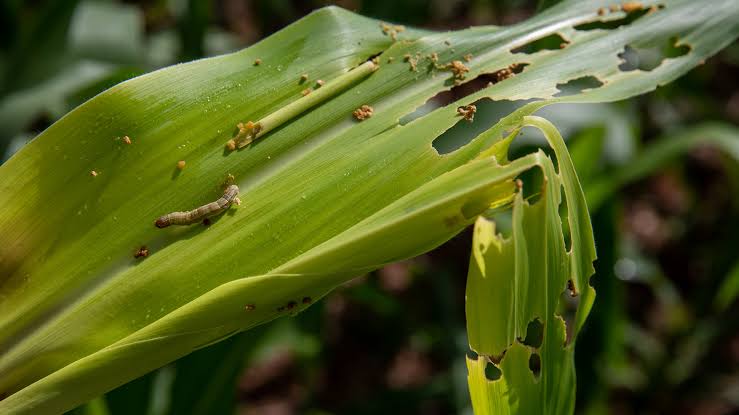
The pest causes damage at different stages of maize development. Young caterpillars feed on leaves, creating transparent patches commonly described as window-pane damage. As they grow, they chew larger holes in leaves and move into the maize whorl, where they feed on developing plant tissues.
Farmers can identify suspected infestation through the following signs:
-
Irregular holes and ragged edges on maize leaves.
-
Transparent patches on young leaves.
-
Sawdust-like droppings, known as frass, inside the maize funnel.
-
Caterpillars hiding inside the whorl.
-
Damaged growing points and stunted plants.
The Kenya Agricultural and Livestock Research Organization (KALRO) recommends regular field inspections, pheromone traps and early intervention as part of integrated pest management.
The severity of the damage depends on the crop’s growth stage, infestation levels and the effectiveness of control measures. Although some maize plants can recover from moderate leaf damage, severe infestations during early growth can compromise crop development and reduce harvests.
Practical solutions to fall armyworm infestation in Kenya
Managing fall armyworm requires more than relying on chemical pesticides. Agricultural experts recommend integrated pest management (IPM), which combines preventive, biological, physical and chemical approaches to reduce pest populations while protecting farmers, consumers and the environment.
Here are some practical interventions that can help Kenyan farmers manage the infestation.
1. Strengthen Early Detection and Farm Surveillance
Early detection is one of the most effective ways of preventing fall armyworm from causing extensive damage.
Farmers should inspect their maize fields regularly, particularly during the early stages of crop development. They should examine young leaves, growing points and the inner sections of maize funnels for eggs, caterpillars and fresh feeding damage.
Pheromone traps can also help monitor the presence of adult moths and provide early warnings of possible infestation.
According to FAO, farmers should learn to identify the pest and destroy egg masses and young caterpillars when they find them.
Agricultural extension officers should also strengthen community-level surveillance by helping farmers identify infestations and report unusual pest activity before it spreads across neighbouring farms.
2. Promote biological pest control
Biological control offers an environmentally friendly alternative to excessive pesticide use.
Farmers can use approved biological products containing Bacillus thuringiensis (Bt), a naturally occurring bacterium that produces toxins harmful to susceptible caterpillars. Such products are particularly useful against young fall armyworm larvae when applied correctly.
Neem-based products can also help manage the pest as part of an integrated control programme.
FAO further highlights the importance of protecting beneficial insects, including parasitoid wasps and natural predators, which help reduce fall armyworm populations.
Its guidance notes that parasitoids alone can account for substantial natural mortality among the pest’s populations. Protecting these beneficial organisms requires reducing unnecessary pesticide applications.
3. Encourage Physical Removal of Caterpillars
Smallholder farmers with relatively small maize plots can use physical methods to control early infestations.
This involves inspecting affected plants, removing visible egg masses and picking out caterpillars from maize funnels before destroying them safely.
KALRO also identifies the use of sand, sawdust or soil in affected maize funnels as a possible low-cost intervention.
However, these approaches should be applied carefully and should not replace proper monitoring and other recommended management practices.
kalrotimps.com+1
4. Adopt Crop Rotation and Intercropping
Continuous maize cultivation can create favourable conditions for pest populations to persist between growing seasons.
Farmers can reduce reliance on maize monoculture by incorporating suitable alternative crops, including beans, cowpeas and other legumes.
Crop rotation helps diversify farming systems, while intercropping can improve land utilisation and contribute to soil fertility.
KALRO recommends intercropping maize with legumes as part of improved maize production practices. Meanwhile, FAO encourages farmers to understand how mixed cropping can influence fall armyworm behaviour and its ability to locate host plants.
5. Promote early and coordinated planting
Planting maize at the recommended time can help farmers avoid conditions that encourage the build-up of fall armyworm populations.
Farmers should coordinate planting within their communities where possible, rather than allowing widely scattered planting dates that leave young maize available throughout the season.
They should also avoid establishing new maize fields close to heavily infested crops without consulting agricultural extension officers.
The Kenya Agricultural and Livestock Research Organization identifies early planting and avoiding late or off-season planting as important cultural management practices.
6. Use pesticides responsibly and avoid overdependence
Chemical pesticides may be necessary when infestation reaches damaging levels, but indiscriminate spraying can worsen the problem by destroying beneficial insects and encouraging pesticide resistance.
Farmers should consult agricultural extension officers and use only products registered by Kenya’s Pest Control Products Board (PCPB) for fall armyworm management.
A 2026 study published in the Journal of Integrative Agriculture, examining integrated fall armyworm management in Kenya and Ghana, found that emamectin benzoate and chlorantraniliprole performed better than lambda-cyhalothrin in the trials. The study also highlighted the potential of resistant local maize varieties and sand-mediated application techniques.
Farmers should therefore:
-
Select products specifically registered for the intended crop and pest.
-
Follow the manufacturer’s recommended application rates.
-
Target the maize whorl where young caterpillars hide, as directed by the product label.
-
Rotate insecticides with different modes of action to reduce resistance.
-
Wear appropriate protective clothing during application.
-
Observe pre-harvest intervals and other safety instructions.
-
Avoid mixing different pesticides without professional guidance.
FAO cautions that excessive pesticide use can harm human health, the environment and beneficial organisms without necessarily delivering effective pest control.
7. Invest in farmer training and extension services
Limited knowledge of pest identification and management remains a challenge for smallholder farmers.
The government, agricultural research institutions and development partners should expand farmer training through agricultural training centres, demonstration farms and farmer field schools.
The three-year FAO-China South-South Cooperation project implemented in Kenya and Ghana demonstrates the importance of practical training in sustainable pest management.
In Bungoma, the demonstration activities at Mabanga Agricultural Training Centre helped farmers acquire skills in identifying fall armyworm, monitoring infestations and adopting environmentally friendly control measures.
Such initiatives should be expanded to other maize-producing counties to ensure that more farmers benefit from practical agricultural knowledge.
County governments should also strengthen agricultural extension services by providing farmers with timely information, field demonstrations and access to qualified crop protection specialists.
What government and agricultural stakeholders should do
The growing threat of fall armyworm calls for coordinated interventions beyond individual farm-level efforts.
First, the national government should strengthen pest surveillance and early-warning systems to improve the detection and monitoring of infestations across maize-producing regions.
Second, agricultural research institutions such as KALRO should intensify research into locally adapted maize varieties with resistance or tolerance to fall armyworm.
Third, county governments should increase investment in farmer education, particularly in areas where maize production supports household incomes and local food markets.
There is also a need to improve access to affordable biological pesticides and other environmentally sustainable pest management technologies.
Additionally, agricultural cooperatives can play a critical role by organising group training, facilitating access to approved crop protection products and helping farmers share information about emerging infestations.
Fall armyworm remains a significant threat to Kenya’s maize production, with the latest FAO warning highlighting the urgency of strengthening pest management interventions.
However, the challenge cannot be addressed through chemical spraying alone. Sustainable management requires early detection, biological control, crop diversification, responsible pesticide use and stronger agricultural extension services.
For farmers, adopting integrated pest management practices can help reduce crop losses, protect farm incomes and improve productivity.
For policymakers and agricultural stakeholders, expanding research, surveillance and farmer training will be essential in building a more resilient maize production system.
As Kenya continues to pursue food security and agricultural transformation, protecting maize crops against destructive pests such as fall armyworm must remain a priority.

Author: Moureen Koech
Moureen Koech is a passionate Digital Journalist, an adept Agribusiness Writer with a keen eye for news and an impactful story-teller,whose stories provide key value to Agripreneurs and stakeholders in the Agricultural sector