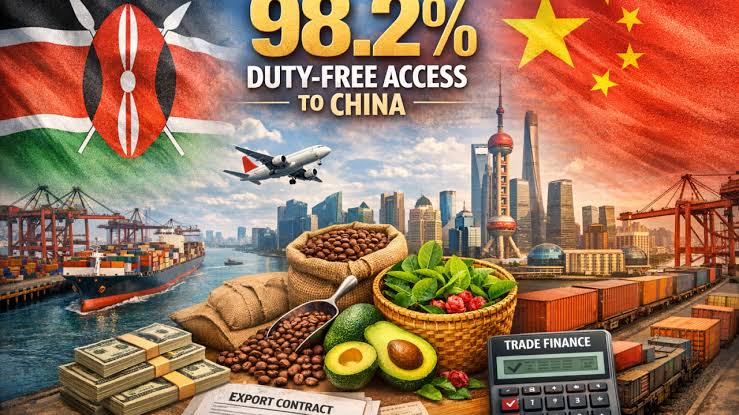
China is the world’s second-largest economy, and Kenyan farmers now have a cheaper way into it. Duty-free access to China took effect on 1 May 2026, removing tariffs that once made Kenyan produce more expensive than competitors’ goods. For farmers, exporters and agribusiness startups, it is one of the biggest trade openings in years.
What is the duty-free arrangement?
Agriculture Cabinet Secretary Mutahi Kagwe announced that Kenyan agricultural products would enter China at zero tariff from 1 May 2026. The change is part of a wider Chinese policy. China said it would fully implement zero tariffs on imports from the 53 African countries it has diplomatic ties with. Kenya had previously been left out of China’s earlier duty-free offer, which mainly benefited the least developed countries. The new deal changes that. It covers about 98.2 per cent of Kenyan exports under the Kenya-China Early Harvest Agreement, including agriculture, minerals and value-added goods.
Which products benefit?
The list includes tea, coffee, fresh and frozen avocados, macadamia nuts, flowers, vegetables, herbs and other fresh horticultural produce. The deal also reaches beyond raw produce. Value-added items such as leather, natural resins, gums and processed agricultural products are covered too. Livestock is another area of interest, and Kenya has been seeking a fast-tracked meat export deal with China.
Early results
Kenya moved quickly. The first consignment, flagged off on 23 March, included fresh avocados, coffee and green beans. Later, China confirmed that a shipment of 6.9 tonnes of fresh Kenyan avocados had arrived under the new arrangement. There is also room to grow. In 2025, coffee and tea exports to China were worth US$24.46 million, and fresh and frozen avocados and macadamia nuts added US$19.9 million. Those figures show how small the starting base is compared with the market’s size.
What exporters must do to qualify
Zero tariff does not mean zero paperwork. Exporters must register with both Kenyan authorities and China’s General Administration of Customs (GACC), hold the relevant business and product licences, and meet sanitary and phytosanitary requirements, including KEPHIS phytosanitary certification. Products must also carry Chinese-language labels showing details such as the product name, origin, ingredients, dates and the GACC registration number.
GACC registration is the step many small businesses overlook. China’s ambassador has stressed that without registration, companies cannot export or enjoy the preferential policies. The approval of Kenyan dried chillies shows how this works in practice. Commercial exports can begin only after farms, processing plants and packing facilities meet Kenyan and Chinese requirements, and each shipment needs a phytosanitary certificate.
Opportunities in Value Addition
Officials want Kenya to ship more than raw produce. Kagwe has said the country should maximise the opportunity by exporting more value-added agricultural products. He has also urged local investors to partner with Chinese companies on processing. That opens doors for packaged avocado products, roasted and ground coffee, branded tea, processed macadamia, dried vegetables and spices. Processing also lets exporters keep more of the profit and cushions them against fresh-produce price swings.
Challenges to expect
The biggest hurdle is compliance. Industry players point to inconsistent product standards, weak traceability systems and limited capacity to meet strict phytosanitary demands. Smallholders face a special problem, since training for small farms and exporters on Chinese phytosanitary requirements has been called for. Chinese buyers must also be found. Tariff-free entry does not create sales on its own. Kenya’s trade officials see events like the China International Import Expo as a bridge between policy access and real sales.
Practical steps for farmers and Agribusinesses
If you want to tap this market, start with compliance rather than production. Check whether your product is eligible, then register with the relevant Kenyan authorities and with GACC. Work with KEPHIS on certification, improve traceability from farm to packhouse and prepare Chinese-language labelling. Smallholders will find it easier to join a cooperative or an established exporter than to go alone.
Therefore, China’s zero-tariff policy gives Kenya a real price advantage in a huge market and early shipments show it is working. But the winners will be the producers who meet the standards, add value and build lasting buyer relationships. As one commentary put it, the policy is an opening rather than an end in itself. The opening is there and compliance and quality will decide who benefits.

Author: Moureen Koech
Moureen Koech is a passionate Digital Journalist, an adept Agribusiness Writer with a keen eye for news and an impactful story-teller,whose stories provide key value to Agripreneurs and stakeholders in the Agricultural sector