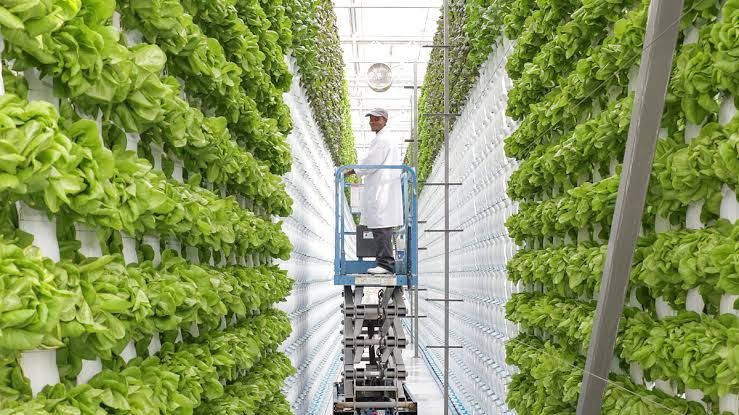
Vertical farming has emerged as one of the most talked-about innovations in modern agriculture. Instead of growing crops across large areas of horizontal land, vertical farming involves cultivating plants in stacked layers, often inside controlled environments such as warehouses, greenhouses or specially designed buildings. The approach is gaining attention as farmers, agribusinesses and investors search for ways to produce more food while dealing with limited land, changing weather patterns and growing urban populations.
But an important question remains: **Is vertical farming actually profitable, or has it been overhyped?** The answer depends on the crops being grown, the technology used, access to markets, energy costs and how efficiently the farm is managed.
What is Vertical Farming?
Vertical farming is an agricultural production system that uses vertical space to grow crops in multiple layers. Plants may be cultivated using hydroponics, aeroponics or other soilless farming techniques. These systems allow farmers to control important growing conditions such as water, nutrients, temperature, humidity and lighting.
Because crops can be grown in controlled environments, vertical farms are less dependent on traditional weather conditions. This can make it possible to produce vegetables throughout the year, including during periods when outdoor farming would be difficult.
Vertical farming is particularly suited to crops such as leafy vegetables, herbs, microgreens and some strawberries. However, not every crop is economically suitable for vertical production.
Why vertical farming is attracting farmers
One of the biggest advantages of vertical farming is its efficient use of land. A vertical farm can produce crops on several levels within the same physical footprint. This makes the system attractive in urban areas and places where agricultural land is expensive or scarce.
Another advantage is water efficiency. Many vertical farms use recirculating systems that allow water to be collected and reused. Compared with conventional agriculture, this can significantly reduce water consumption when the system is properly designed and managed.
Vertical farming can also offer greater control over production. Farmers can regulate factors such as light, temperature and nutrients, potentially reducing the impact of droughts, heavy rainfall and some pests and diseases. This can result in more predictable production throughout the year.
For urban consumers, vertical farming can also shorten the distance between farms and markets. Fresh produce can potentially be grown close to restaurants, supermarkets and households, reducing transportation time and helping farmers supply highly perishable products while they are still fresh.
Where the profitability comes from
The profitability of vertical farming largely depends on selling crops that can command relatively high prices. Leafy greens, herbs and microgreens are among the crops that may work well because they have relatively short production cycles and can be sold to restaurants, supermarkets, hotels and health-conscious consumers.
Consistent production can also create an advantage for farmers who establish reliable buyers. Instead of depending entirely on seasonal outdoor production, a well-managed vertical farm can supply customers throughout the year.
However, high production capacity does not automatically translate into profits. A farmer may produce large quantities of vegetables and still make losses if electricity, equipment, labour, seeds, nutrients, packaging and other operating expenses are too high.
The high cost of starting a vertical farm
One of the biggest challenges facing vertical farming is the initial investment. Commercial systems can require substantial spending on growing racks, irrigation systems, climate-control equipment, sensors, pumps, lighting and other infrastructure.
Electricity can also become a major expense, particularly in systems that rely heavily on artificial lighting and climate control. In countries where electricity prices are high or unreliable, energy costs can significantly affect profit margins.
Farmers therefore need to conduct a detailed feasibility study before investing. The cost of construction and equipment should be compared with expected production, selling prices, operating expenses and the amount of time required to recover the investment.
Starting small can sometimes be a more practical approach. A farmer can test the technology with a manageable production unit, identify reliable customers and understand the real operating costs before expanding.
Is vertical farming overhyped?
There is some justification for the criticism that vertical farming has been overhyped. The technology is often presented as a solution to almost every agricultural challenge, yet it has limitations.
Vertical farming does not eliminate production costs. In fact, it can introduce expenses that traditional farmers may not face at the same level, particularly electricity, equipment maintenance and technical management.
The technology is also not ideal for every crop. Growing maize, wheat or other large field crops in stacked indoor systems would generally be economically difficult because of their relatively low market value and the amount of space required.
This means vertical farming should not be viewed as a replacement for conventional agriculture. Instead, it should be considered another production method that works best under specific conditions.
Opportunities for Kenyan farmers
Vertical farming could provide opportunities for Kenyan farmers and agribusiness entrepreneurs, particularly around major towns and cities where demand for fresh vegetables is high. Urban consumers, hotels, restaurants and supermarkets can provide potential markets for premium-quality produce.
However, Kenyan entrepreneurs should pay close attention to energy costs, availability of equipment, technical skills and market demand before investing. A system that is profitable in another country may not automatically be profitable in Kenya.
Farmers should first identify the target market and determine what customers are willing to pay. They should then calculate production costs and select crops based on market demand rather than simply choosing a crop because it is popular in vertical farming.
How to make vertical farming more profitable
Successful vertical farming requires careful business planning. Farmers should focus on crops with strong local demand, short production cycles and attractive selling prices.
Energy efficiency should also be a priority. Using efficient lighting, appropriate climate-control systems and renewable energy where economically viable can help reduce operating expenses.
Another important strategy is establishing markets before expanding production. Contracts or strong relationships with restaurants, retailers, hotels and other buyers can provide greater certainty than producing crops first and searching for customers later.
Farmers should also maintain accurate records of electricity use, labour, seed costs, nutrients, yields, spoilage and sales. These records make it easier to determine whether the enterprise is genuinely profitable.
The future of vertical farming
Vertical farming is unlikely to disappear, but its future will probably depend on becoming more efficient and economically realistic. Improvements in renewable energy, automation, lighting technology, sensors and crop science could reduce some of the costs associated with controlled-environment agriculture.
The strongest businesses are likely to be those that treat vertical farming as an agricultural enterprise rather than simply a technological experiment. Technology can improve production, but profitability ultimately depends on costs, crop selection, productivity and access to customers.
So, is vertical farming profitable or overhyped? It can be profitable, but it is not automatically profitable.Its success depends on location, crop choice, energy costs, technology, management and market access.
For farmers and agribusiness entrepreneurs, the best approach is to avoid investing because vertical farming is fashionable. Instead, conduct a feasibility study, start at a manageable scale, identify profitable crops and secure markets before making major investments.
Vertical farming should therefore be viewed neither as a miracle solution nor as an agricultural fad. When matched with the right crops, technology, market and business model, it can become a valuable part of modern agriculture.

Author: Moureen Koech
Moureen Koech is a passionate Digital Journalist, an adept Agribusiness Writer with a keen eye for news and an impactful story-teller,whose stories provide key value to Agripreneurs and stakeholders in the Agricultural sector