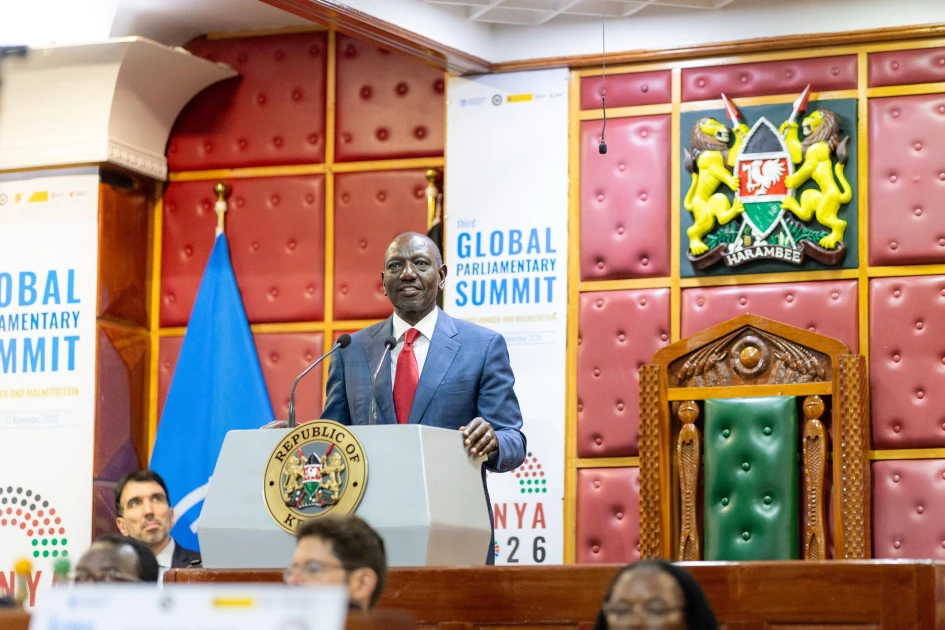
The President said the government plans to construct 50 mega dams, 200 medium-sized dams and thousands of micro-dams over the next five to seven years to reduce the country’s dependence on rainfall.
Speaking on Monday, November 16, 2026, during the opening of the Third Global Parliamentary Summit Against Hunger and Malnutrition at Parliament Buildings in Nairobi, Ruto said irrigation was central to increasing agricultural production and protecting farmers against climate-related shocks.
“Lack of rainfall does not mean a lack of water. That is why we have intensified large-scale irrigation investments through our National Infrastructure Fund,” he said.
The President noted that unpredictable rainfall, particularly in arid and semi-arid areas, continued to expose millions of Kenyans to food insecurity and malnutrition.
He disclosed that approximately 2.7 million Kenyans were experiencing crisis-level food insecurity, with vulnerable women and children requiring urgent support.
According to Ruto, malnutrition costs Kenya an estimated 6.9 per cent of its Gross Domestic Product (GDP), highlighting the economic consequences of inadequate food and nutrition.
Government cites increase in agricultural production
The Head of State said his administration had shifted agricultural support towards production, with fertiliser subsidies forming part of efforts to improve farm productivity and reduce production costs.
He reported that the government had distributed more than 38 million bags of subsidised fertiliser to approximately two million farmers since 2022.
The intervention, he said, had contributed to a 73 per cent reduction in fertiliser costs since 2022.
Ruto also highlighted growth in maize production, which increased from 34 million bags in 2022 to 71 million bags in 2025, helping reduce the country’s dependence on maize imports.
The government is banking on affordable agricultural inputs, increased irrigation and improved production to strengthen domestic food supplies.
School feeding programme targets 10 million learners
The President further announced plans to expand the national school feeding programme, which currently benefits approximately three million learners.
He said the government intended to increase the number of beneficiaries to 10 million by 2030, with expansion expected between 2027 and 2030.
The programme is also expected to create reliable markets for local agricultural producers by linking school meals to food sourced from farmers.
This approach could provide smallholder farmers with more predictable demand while improving access to nutritious meals among school-going children.
Ruto challenges lawmakers to prioritise food security
Beyond Kenya’s domestic agricultural interventions, Ruto challenged legislators across the world to strengthen laws, increase agricultural budgetary allocations and improve oversight of food security programmes.
He argued that political commitments alone would not eliminate hunger unless governments translated them into funded programmes and enforceable legislation.
“A right without a budget line is a slogan,” he said, urging parliamentarians to scrutinise public expenditure and ensure investments in agriculture, irrigation, school feeding and social protection deliver measurable results.
The President also called for stronger regional agricultural trade through the African Continental Free Trade Area (AfCFTA).
He urged African countries to address non-tariff barriers and harmonise trade standards to facilitate the movement of agricultural products across borders.
According to him, improved regional trade would expand markets for farmers, strengthen food systems and create opportunities for agricultural value addition.
FAO calls for affordable and nutritious food
Food and Agriculture Organization (FAO) Deputy Director-General Maurizio Martina commended Kenya’s efforts to prioritise agriculture through interventions targeting production, irrigation, reduced input costs and value addition.
However, he cautioned that increased agricultural production should go hand in hand with improving people’s access to affordable and healthy diets.
“Hunger is not inevitable. We cannot confuse progress with success,” Martina said.
He emphasised the importance of legislation and accountability in ensuring that agricultural investments translate into tangible improvements in people’s lives.
The summit comes against a backdrop of persistent global food insecurity. Figures cited during the meeting indicated that approximately 645 million people experienced hunger globally in 2025, including about 309 million in Africa.
Kenya hosts first African edition of global summit
The two-day Third Global Parliamentary Summit Against Hunger and Malnutrition is being held in Nairobi from November 16 to 17, 2026.
The gathering has brought together more than 250 parliamentarians from 65 countries, alongside development partners and other stakeholders.
It is jointly organised by the Parliament of Kenya, FAO and the Spanish Agency for International Development Cooperation (AECID).
The meeting is being held under the theme Legislating for Resilient Agrifood Systems and Zero Hunger in a Changing Climate.
Kenya is the first African country to host the summit, following previous editions in Spain in 2018 and Chile in 2023.
Senate Speaker Amason Kingi also called on legislators to prioritise food security in national budgets, strengthen oversight and ensure that the right to adequate food is reflected in legislation and public investment.
The discussions are focusing on the right to food, access to healthy diets and the development of inclusive, resilient and sustainable agrifood systems.
The summit provides an opportunity for participating countries to exchange experiences and develop legislative and policy approaches to addressing hunger, malnutrition and the effects of climate change on agricultural production.

Author: Moureen Koech
Moureen Koech is a passionate Digital Journalist, an adept Agribusiness Writer with a keen eye for news and an impactful story-teller,whose stories provide key value to Agripreneurs and stakeholders in the Agricultural sector