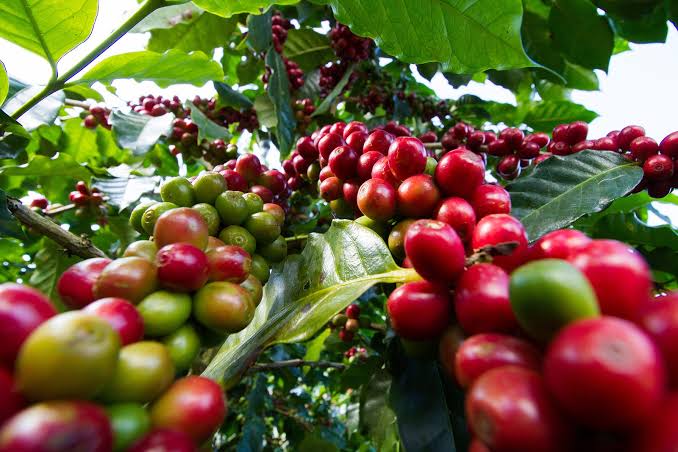
Improved coffee prices, stronger cooperative societies and increased government support are breathing new life into coffee farming in Nandi County, with more growers returning to the crop after years of neglect in search of better incomes and long-term financial stability.
The resurgence has been fuelled by strong performances at the Nairobi Coffee Exchange, where Kenyan coffee has continued to attract competitive prices due to growing demand for premium Arabica beans in international markets. The encouraging returns have inspired farmers to rehabilitate ageing coffee bushes, establish new plantations and adopt improved farming practices to boost productivity and quality.
According to the latest coffee marketing data, Nandi has emerged among Kenya’s leading coffee-producing counties after delivering more than 2.2 million kilogrammes of clean coffee worth nearly Sh2 billion during the current coffee season. The milestone reflects years of sustained investment in coffee production, improved crop husbandry and reforms within cooperative societies.
Nandi governor, Stephen Sang said the county’s growing reputation as a coffee producer demonstrates the success of deliberate interventions aimed at reviving agriculture as the backbone of the local economy.
He noted that the county government has prioritised the distribution of certified coffee seedlings, farmer training, extension services and the strengthening of cooperatives to enable growers to produce high-quality coffee that attracts premium prices.
“Our goal is to ensure coffee farming remains a profitable enterprise for thousands of families. We are investing in quality production, better marketing systems and value addition so that farmers earn more from every kilogramme they produce,” said Sang.
Coffee farming has become an increasingly important source of income in Nandi, where agriculture supports the majority of households alongside tea, dairy and maize production. County officials estimate that more than 30,000 families directly depend on coffee cultivation and related value chains for their livelihoods.
Across the coffee-growing areas of Tinderet, Nandi Hills, Aldai, Chesumei and Mosop sub-counties, many farmers are rehabilitating neglected coffee plantations while others are increasing acreage under the crop following improved returns.
Agricultural experts attribute the improved earnings to favourable global coffee prices, better post-harvest handling, enhanced quality control and reforms that have improved transparency in coffee marketing.
They also credit increased farmer awareness of modern agronomic practices such as timely pruning, mulching, soil fertility management, integrated pest management and proper harvesting techniques, all of which contribute to improved yields and bean quality.
County Executive Committee Member for Agriculture Dr Bernard Lagat said the county intends to significantly increase coffee production over the next few years by replacing ageing coffee bushes, expanding acreage under cultivation and improving extension services.
“We are positioning Nandi to become one of Kenya’s leading coffee-producing regions by helping farmers increase productivity while maintaining the high quality that buyers are looking for,” said Lagat.
The national government’s ongoing reforms in the coffee sector have also strengthened farmer confidence. Recent policy measures aimed at improving cooperative governance, ensuring prompt payments to farmers, enhancing access to quality farm inputs and streamlining coffee marketing are expected to further boost the sector’s competitiveness.
Tinderet Member of Parliament Julius Melly has continued to encourage farmers to diversify from overdependence on maize by embracing coffee as a reliable commercial crop capable of generating stable long-term income.
“We must continue supporting our farmers with training, improved infrastructure and stronger cooperatives because coffee has demonstrated its potential to transform rural economies,” he said.
Nandi Woman Representative Cynthia Muge has also intensified efforts to promote coffee farming through the Mama na Kahawa initiative, which supports women’s groups with certified coffee seedlings and technical training.
She said empowering women and young people to participate in coffee farming would strengthen household incomes while ensuring the sustainability of the county’s coffee industry.
“Women have become key drivers of coffee production. By supporting organised groups, we are not only improving family incomes but also encouraging the next generation to view agriculture as a profitable business,” said Muge.
The operationalisation of the Chebonet Coffee Mill in Tinderet Sub-county has further strengthened the coffee value chain by reducing milling costs, improving processing efficiency and enabling farmers to preserve bean quality before marketing.
Agronomists say Nandi possesses ideal ecological conditions for producing premium Arabica coffee because of its fertile volcanic soils, favourable altitude, reliable rainfall and moderate temperatures, giving the county a competitive advantage in both local and international markets.
The improved fortunes in coffee farming are already stimulating economic activity in rural trading centres, with increased demand for agricultural inputs, construction materials, transport services and household goods as farmers reinvest their earnings.
Stakeholders believe the county still has significant untapped potential and have called for greater investment in irrigation, climate-smart agriculture, value addition, coffee roasting, branding and direct market access to enable farmers to earn even higher returns.
As Kenya continues to strengthen its position in the global coffee market, Nandi’s coffee revival is increasingly being viewed as a model of how strategic government support, stronger cooperatives and quality-focused production can improve rural livelihoods whilecontributing to national agricultural growth.

Author: Moureen Koech
Moureen Koech is a passionate Digital Journalist, an adept Agribusiness Writer with a keen eye for news and an impactful story-teller,whose stories provide key value to Agripreneurs and stakeholders in the Agricultural sector