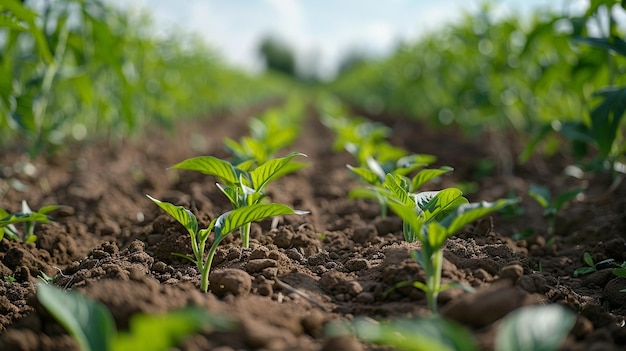
Crop spacing is one of the most important agronomic practices that directly affects crop health, yieldband farm profitability. Many farmers focus on seeds, fertilizers and pesticides but often overlook spacing, yet it determines how well crops compete for sunlight, water and nutrients. Understanding crop spacing helps farmers maximize production from every piece of land.
This guide explains crop spacing in agriculture using clear questions and answers to help farmers apply the correct practices in the field.
What is crop spacing in agriculture?
Crop spacing refers to the distance maintained between plants in the field to allow proper growth and development. It ensures that each plant has enough room to access essential resources such as sunlight, water, nutrients and air circulation.
In simple terms, crop spacing is how farmers organize plants in the field to avoid overcrowding and improve productivity.
Why is crop spacing important?
Proper crop spacing is essential because it directly influences plant performance. When crops are spaced correctly, they grow healthier and produce higher yields.
Good spacing allows:
- Adequate sunlight penetration
- Proper air circulation
- Efficient water absorption
- Better nutrient uptake
Without proper spacing, crops struggle to grow efficiently and become weak or unproductive.
What happens if crops are planted too close together?
When crops are overcrowded, they compete for limited resources such as nutrients, water and sunlight. This leads to several problems:
- Weak and stunted growth
- Low crop yields
- Increased spread of diseases
- Higher pest infestation
Poor spacing creates a humid environment that encourages fungal and bacterial infections, which can destroy an entire crop field.
What happens if crops are planted too far apart?
While overcrowding is harmful, excessive spacing is also a problem. When plants are too far apart:
- Land is underutilized
- Weed growth increases between plants
- Total yield per acre decreases
- Farming becomes less profitable
The goal is to find the correct balance for maximum productivity.
Types of crop spacing
There are two main types of crop spacing in agriculture:
1. Row Spacing
Row spacing is the distance between one row of crops and the next. It helps farmers organize fields in a structured way.
2. Intra-Row Spacing
Intra-row spacing is the distance between individual plants within the same row. It determines how much space each plant has to grow.
Both types of spacing are important for proper crop development.
Why is row spacing important?
Row spacing plays a major role in farm management. It allows:
- Easy movement during weeding
- Efficient spraying of pesticides
- Smooth irrigation practices
- Simple harvesting operations
Proper row spacing is especially important in mechanized farming where machines need space to operate.
Why is Intra-Row Spacing Important?
Intra-row spacing ensures that each plant has enough room to develop roots, stems, leaves, and fruits. It reduces competition between plants and promotes uniform growth, resulting in better quality produce.
How is Crop Spacing Written?
Crop spacing is usually written as:
- Row spacing × Plant spacing
For example, 60 cm × 60 cm means:
- 60 cm between rows
- 60 cm between individual plants in the same row
This standard format helps farmers easily follow planting guidelines.
Why do different crops need different spacing?
Different crops have different growth patterns, canopy sizes, and root systems. For example, leafy vegetables require more space than root crops, while cereals like maize need wider spacing for proper development.
Each crop has recommended spacing based on agricultural research to ensure maximum yield.
Common crop spacing examples
Different crops require different spacing for optimal growth:
- Cabbage: 60 cm × 60 cm
- Tomatoes: 60 cm × 45 cm
- Onions: 30 cm between rows × 10 cm between plants
- Maize: 75 cm × 25–30 cm
- Beans: 50 cm × 10–15 cm
Following these recommendations helps farmers achieve better harvests.
How does crop spacing affect yield?
Correct spacing improves plant health and maximizes production per unit area. When plants are well spaced, they grow stronger and produce more fruits or grains, increasing overall farm yield.
How does spacing affect pest and disease control?
Proper spacing improves air circulation, which reduces humidity in the crop canopy. This makes it harder for pests and diseases to spread, resulting in healthier crops and lower production losses.
How does spacing affect fertilizer use?
When crops are properly spaced, fertilizer is distributed more efficiently. Each plant gets adequate nutrients without excessive competition, improving fertilizer effectiveness and reducing waste.
Tools used to measure crop spacing
Farmers can use simple tools such as:
- Measuring tapes
- Ropes
- Wooden sticks
- Planting lines
A planting line is especially useful because it has marked intervals that guide correct plant spacing during planting.
Importance of crop spacing in weed control
Proper spacing allows farmers to easily access the field for weeding. Wider rows make it easier to remove weeds manually or mechanically, reducing competition for nutrients.
What happens if spacing recommendations are ignored?
Ignoring recommended spacing leads to:
- Poor yields
- Increased pest and disease problems
- Difficult farm management
- Reduced profitability
Farmers may lose a significant portion of their harvest due to poor spacing practices.
Does soil fertility affect crop spacing?
Yes. Fertile soils can support slightly closer spacing because nutrients are abundant. Poor soils, on the other hand, require wider spacing to reduce competition among plants.
Does irrigation influence spacing?
Irrigated farms may allow slightly higher plant populations since water is readily available. However, spacing should still follow crop-specific recommendations.
Why should farmers follow recommended spacing?
Recommended spacing is based on agricultural research and field trials. These guidelines are designed to give farmers the best possible yield under normal conditions.
Crop spacing in agriculture is a simple but powerful practice that determines farm success. When farmers maintain correct spacing, crops grow healthier, yields increase and farm management becomes easier.
The main benefit of proper crop spacing is clear: healthy plants, higher yields, and more profitable farming.

Author: Moureen Koech
Moureen Koech is a passionate Digital Journalist, an adept Agribusiness Writer with a keen eye for news and an impactful story-teller,whose stories provide key value to Agripreneurs and stakeholders in the Agricultural sector