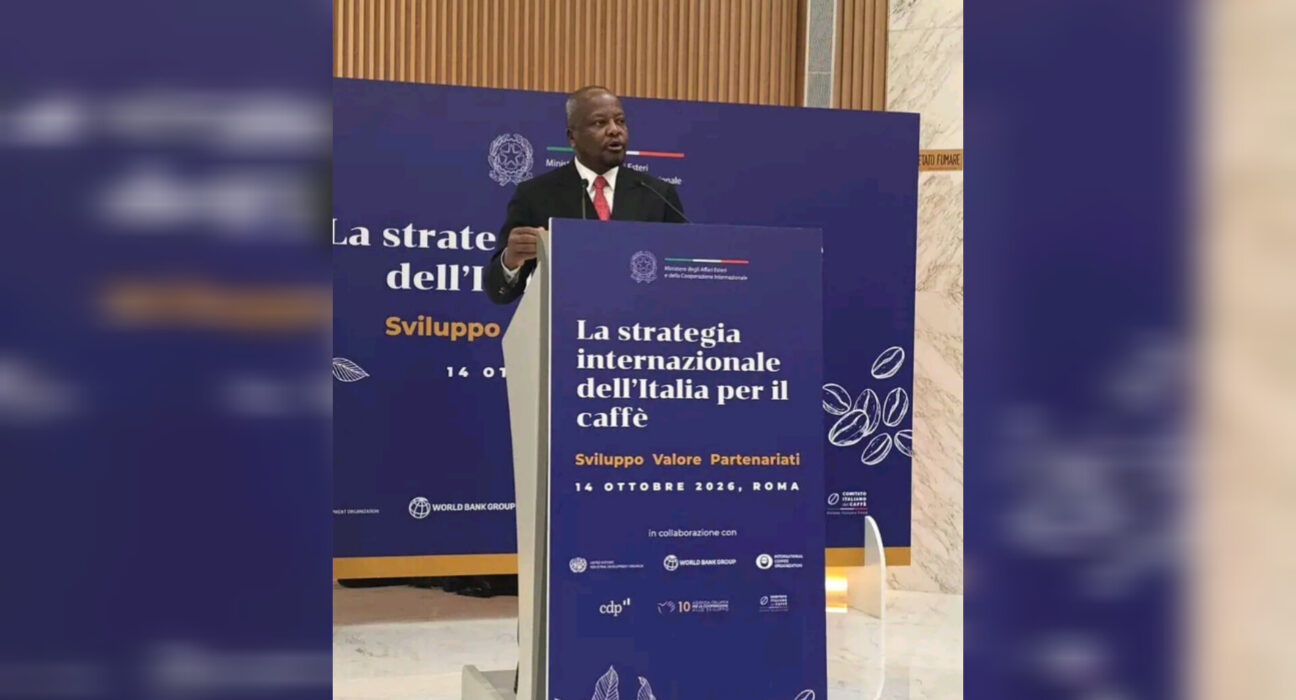
Agriculture and Livestock Development Cabinet Secretary Mutahi Kagwe has called for reforms in the global coffee industry, urging producing countries, international buyers and processors to prioritise farmers’ earnings to secure the sector’s long-term future.
Speaking at Italy’s International Coffee Strategy Forum in Rome on October 14, 2026, Kagwe warned that the sustainability of the coffee industry depends on making production economically viable for farmers and strengthening partnerships between producing and consuming countries.
“The entire global coffee value chain depends on the farmer,” Kagwe said.
He argued that coffee companies must invest in the welfare of producers, warning that inadequate returns could push farmers towards alternative agricultural enterprises and threaten future supplies.
The Cabinet Secretary cited Kenya’s declining coffee production, which has fallen from approximately 150,000 metric tonnes to 50,000 metric tonnes, as evidence of the challenges facing the sector.
The figures highlight concerns about the competitiveness of coffee farming, particularly where farmers struggle to earn sufficient income from their produce.
Kagwe called for policies that improve farmer earnings, strengthen regulation and expand international markets, saying the industry must address challenges at the production level if it is to remain sustainable.
Coffee reforms target farmer earnings
The CS pointed to Kenya’s Coffee Act as an important step towards strengthening regulation in domestic and export markets.
He said improved regulatory frameworks, supported by research and productivity-enhancing measures, could help restore confidence in coffee farming and improve the sector’s performance.
The reforms are intended to address challenges across the value chain, from production and marketing to access to international buyers.
Kagwe’s remarks come amid broader efforts to strengthen Kenya’s agricultural exports and improve returns to producers. For coffee farmers, the viability of the crop depends not only on international demand but also on the prices and earnings they receive.
The Cabinet Secretary urged international coffee companies to recognise that their commercial interests are linked to the prosperity of the farmers supplying their raw materials.
He called for closer cooperation among governments, processors, exporters and other industry players to ensure that growth in the global coffee market translates into better livelihoods for producers.
Kenya seeks stronger international coffee brand
Kagwe also called for deliberate investment in promoting Kenyan coffee internationally, drawing comparisons with efforts to market Kenyan tea.
He urged governments and private-sector players to work together to increase global coffee consumption and create new market opportunities for producing countries.
Stronger international branding could help raise the profile of Kenyan coffee and expand its reach among consumers, particularly in markets where quality and product identity influence purchasing decisions.
The push also highlights the importance of moving beyond the export of raw agricultural commodities towards greater value addition, including processing, packaging and branding.
By strengthening its international presence, Kenya could seek to capture more value from its coffee while improving opportunities for producers and businesses across the supply chain.
Kagwe raises concerns over EU deforestation rules
The Cabinet Secretary also called for international trade regulations to reflect the realities of agricultural production, particularly in relation to the European Union Deforestation Regulation (EUDR).
He emphasised the need to recognise coffee as a tree crop and ensure that compliance requirements account for conditions on the ground.
The EU regulation introduces requirements intended to prevent products associated with deforestation from entering or being traded in the European market. Coffee is among the commodities covered by the rules.
For producing countries such as Kenya, compliance involves addressing traceability and demonstrating that relevant products meet the applicable requirements.
Kagwe’s position underscores the need for engagement between producing countries and international markets to ensure that environmental objectives are pursued alongside practical consideration of farmers’ circumstances.
Digital technology and research partnerships
Kagwe also highlighted digital transformation as an opportunity to modernise coffee trading and improve access to international markets.
He said digital platforms could connect smallholder farmers more directly with overseas buyers, improve transparency and help producers access market information.
Stronger digital connections could also support better communication across the value chain, potentially reducing information gaps between farmers, traders and buyers.
The Cabinet Secretary further highlighted Kenya’s collaboration with Italy and the United Nations Industrial Development Organization (UNIDO) in establishing the Coffee Research and Training Institute in Nairobi.
The partnership reflects the role of international cooperation in strengthening agricultural research, developing technical skills and improving the competitiveness of the coffee sector.
Research and training are important to efforts to improve productivity, support farmers and equip industry participants with the knowledge required to respond to changing market conditions.
Global partnerships in focus
Kagwe’s participation in the Rome forum formed part of wider international discussions on the future of the coffee industry, bringing together government representatives, international organisations and private-sector leaders.
According to Italy’s Ministry of Foreign Affairs, the October 14 event focused on strengthening partnerships between producing countries, international organisations, financial institutions and businesses across the coffee supply chain.
Italy also presented initiatives aimed at supporting a more sustainable and competitive industry, including ACT Coffee, which focuses on sustainable transformation of Africa’s coffee value chain, and the Global Coffee Initiative, developed with the World Bank Group and Cassa Depositi e Prestiti to support project development and investment mobilisation.
The discussions placed emphasis on investment, technology transfer and cooperation with coffee-producing countries.
For Kenya, the challenge remains ensuring that such international partnerships translate into stronger production, expanded markets and better returns for farmers.
Kagwe’s message was that protecting producers must remain central to efforts to grow the global coffee market. Without economically viable farming, the industry risks weakening the very foundation on which its future depends.

Author: Moureen Koech
Moureen Koech is a passionate Digital Journalist, an adept Agribusiness Writer with a keen eye for news and an impactful story-teller,whose stories provide key value to Agripreneurs and stakeholders in the Agricultural sector