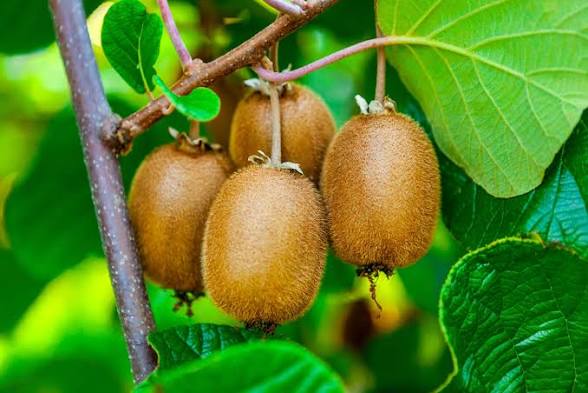
Kiwi farming is attracting growing interest among Kenyan farmers looking for high-value fruit crops that can diversify farm income. But can kiwi grow in Kenya? Yes, kiwi can be grown in suitable parts of the country, particularly in cooler highland areas where temperature, altitude, soil, water availability and pollination conditions are favourable.
However, kiwi is not a crop that should be planted simply because a farm has fertile soil. Successful kiwi production requires careful site selection, adequate chilling conditions, well-drained soil, reliable water, wind protection, strong trellising and proper pollination.
For farmers considering commercial production, understanding these requirements before buying seedlings is essential.
Why are Kenyan farmers interested in Kiwi farming?
Kiwi is a premium climbing fruit with potential for fresh-fruit markets, supermarkets, hotels, restaurants and food-processing businesses. Its potential as a high-value crop makes it an interesting option for farmers seeking alternatives to conventional fruit enterprises.
The crop can also provide an opportunity to diversify income, particularly where farmers have suitable highland land and the infrastructure needed to support a perennial climbing vine.
Nevertheless, farmers should not base investment decisions on attractive fruit prices alone. The first question should be whether the farm’s climate and microclimate are suitable for kiwi production.
What climate does Kiwi need?
Kiwi originated in temperate environments and generally performs best under cool to moderate growing conditions. Unlike tropical fruits that tolerate prolonged high temperatures, kiwi requires an appropriate period of winter chilling for proper dormancy and subsequent flowering.
Published kiwi production guidance commonly places chilling requirements at around 600–800 hours below approximately 7°C, although requirements vary according to cultivar.
This makes Kenya’s cooler highlands more promising than hot lowland areas.
During the growing season, moderate temperatures are desirable. Some local kiwi farming guidance gives broad favourable temperature ranges, but farmers should avoid relying on one temperature figure because cultivar, altitude, exposure and microclimate can significantly affect performance.
The major consideration is whether the farm can provide sufficiently cool conditions without prolonged heat and drought stress.
Best altitude for Kiwi farming in Kenya
Altitude is important because it influences temperature. Areas at higher elevations generally experience cooler conditions than low-lying regions.
A commonly suggested range for kiwi production in Kenya is approximately 1,500–2,500 metres above sea level, although suitability can extend beyond this range depending on cultivar and local conditions.
Potential areas therefore include cooler sections of Central Kenya, the Rift Valley and Western Kenya.
Farmers should remember that being located in a particular county does not automatically make a farm suitable. Two farms within the same county may have very different conditions because of altitude, slope, soil, wind exposure and local temperatures.
Best regions for Kiwi farming in Kenya
Central Kenya Highlands
Potential areas include Kiambu, Murang’a, Nyeri, Nyandarua, Meru and the higher parts of Embu.
These areas can provide suitable combinations of elevation, cool temperatures, fertile soils and rainfall. However, individual farm assessment remains essential.
Rift Valley Highlands
Selected highland areas of Uasin Gishu, Nandi, Kericho, Bomet and Nakuru may also offer favourable conditions.
Farmers in these regions should pay particular attention to drainage, especially in areas receiving substantial rainfall.
Western Kenya Highlands
Parts of Kisii, Nyamira, Trans Nzoia and other highland zones of Western Kenya may also have potential.
High rainfall can be an advantage for water availability, but excessive moisture can become a problem when soils remain saturated.
What soil is best for Kiwi?
Soil testing should be one of the first steps before establishing a commercial kiwi orchard.
Kiwi performs best in deep, fertile and well-drained soils with good aeration and organic matter. Loam and sandy-loam soils are generally preferable where drainage is adequate.
A soil pH of approximately 5.5–6.5 is a useful target for planning, although the final nutrient and pH management programme should be based on laboratory soil-test results.
Farmers should avoid permanently waterlogged soils, shallow soils and heavily compacted land. Kiwi roots require oxygen, and prolonged waterlogging can contribute to root problems and poor plant development.
How much rainfall does Kiwi need?
Kiwi requires adequate moisture, particularly during active growth and fruit development. A useful planning range is approximately 1,000–1,500 mm of annual rainfall, although actual requirements vary according to climate, soil, cultivar and rainfall distribution.
Where rainfall is inadequate or poorly distributed, irrigation is important.
Drip irrigation is a practical option because it supplies water directly to the root zone while reducing unnecessary wetting. Farmers should maintain adequate moisture without creating waterlogged conditions.
Mulching can also help conserve soil moisture and moderate fluctuations in soil conditions.
Does kiwi need full sun?
Kiwi vines require sufficient sunlight for photosynthesis, flowering and fruit development. A site receiving roughly 6–8 hours of good sunlight per day can be favourable.
However, farmers should balance sunlight with protection from excessive heat and strong winds. An exposed farm can experience vine damage, increased water loss and problems with the trellis system.
Windbreaks can therefore be useful, especially in areas prone to strong winds.
Kiwi requires a strong trellis system
One of the most important things to understand about kiwi farming is that kiwi is a climbing vine, not a conventional fruit tree.
Commercial farmers need a strong, permanent support structure consisting of suitable posts, wires and a training framework.
The trellis should be planned before or during orchard establishment rather than after vines have become difficult to manage.
Plant spacing depends on the cultivar and training system. A spacing of around 3 metres by 3 metres is sometimes recommended, but farmers should not automatically assume that this density is appropriate for every orchard.
The final spacing should consider cultivar vigour, soil fertility, irrigation, trellis design and management capacity.
Pollination is critical in Kiwi farming
Pollination is one of the most important considerations when buying kiwi seedlings.
Many commercially grown kiwi types are dioecious, meaning male and female flowers occur on separate plants. Female plants therefore require pollen from compatible male plants to produce fruit.
A commonly cited practical arrangement is approximately one male vine for every six to nine female vines, although the appropriate ratio depends on cultivar, orchard layout and pollination conditions.
Farmers should establish exactly what type of planting material they are buying and whether male and female plants are required before establishing an orchard.
Poor pollination can lead to poor fruit set, fewer fruits and smaller or unevenly developed fruit.
How long does kiwi take to produce fruit?
Kiwi is a long-term investment rather than a quick-return crop.
Under suitable conditions, some nursery guidance indicates that seedlings can begin producing fruit in approximately four to five years. Actual timing can vary depending on cultivar, planting material, climate, pollination, nutrition, pruning and general orchard management.
The early years should therefore focus on establishing strong roots, training vines, developing the canopy, building the trellis system and preparing the orchard for future production.
Farmers should not expect a newly planted orchard to immediately deliver maximum commercial yields.
Is Kiwi Farming Profitable in kenya?
Kiwi farming can potentially be profitable, but profitability is not guaranteed.
Returns depend on mature yields, fruit quality, market prices, labour expenses, irrigation, trellis construction, pest and disease management, harvesting and access to reliable buyers.
Some nursery information gives potential mature-vine yields of around 20–50 kg per plant under suitable conditions. Such figures should be treated as potential performance rather than guaranteed production.
Farmers should prepare business projections using conservative yields and realistic selling prices. Trellis construction and irrigation can represent significant establishment costs and should be included in the investment calculation.
Before purchasing, farmers should confirm the cultivar, planting material quality, male-to-female requirements, delivery conditions and current price directly with the nursery.
How to plant kiwi seedlings
Start by conducting a soil test to determine pH and nutrient status. Correct major soil problems before planting rather than trying to solve them after the orchard has been established.
Prepare the land by removing perennial weeds and improving drainage where necessary. In poorly drained areas, suitable drainage measures or raised planting areas may be considered.
Install or plan the trellis system early, as young vines need support and training from the beginning.
When seedlings arrive, inspect them for damaged roots, severe yellowing, pest infestation, disease symptoms or broken stems. Healthy planting material provides a better foundation for orchard establishment.
After planting, provide sufficient moisture while avoiding standing water. Mulching can help conserve moisture, but mulch should be managed properly to avoid creating excessively wet conditions around the stem.
Pruning and vine training
Kiwi vines are vigorous and require regular training and pruning.
Proper management helps maintain a productive canopy, improve light penetration, control excessive vegetative growth and make harvesting easier. It also helps farmers maintain access between vines and protect the trellis system.
Pruning practices should be adapted to the cultivar and training system rather than simply cutting vines without a clear production strategy.
Kiwi pests and diseases
Kiwi is not completely free from pest and disease problems. Potential challenges can include aphids, mites, fruit flies, bacterial diseases and root problems associated with poor drainage.
Farmers should regularly inspect vines and identify problems early.
Good orchard hygiene, healthy planting material, proper drainage and field monitoring should form the foundation of crop protection. Pesticides should not be applied simply because neighbouring farmers are spraying. The pest or disease should first be correctly identified, and only registered products should be used according to their labels and professional recommendations.
Kiwi farming requirements at a glance
Climate: Cool to moderate highland conditions
Altitude: Approximately 1,500–2,500 metres, depending on cultivar and site
Rainfall: Roughly 1,000–1,500 mm or more, depending on rainfall distribution and irrigation
Soil: Deep, fertile and well-drained loam or sandy-loam soil
Soil pH: Approximately 5.5–6.5 is a useful target
Sunlight: Around 6–8 hours of good sunlight
Water: Reliable moisture, with irrigation where necessary
Wind: Protected sites are preferable
Support: Strong permanent trellis required
Pollination: Male and female vines may be required for dioecious cultivars
Management: Regular pruning, training and canopy management
Fruit production: Often begins around four to five years under suitable conditions
These figures are planning guidelines rather than guarantees because cultivar, microclimate and management can significantly affect results.
Common kiwi farming mistakes to avoid
Farmers should avoid planting kiwi in unsuitable hot areas without assessing the climate, ignoring soil testing, establishing orchards on waterlogged land, underestimating trellis costs and failing to plan pollination.
Other common mistakes include purchasing poor-quality planting material, neglecting irrigation during dry periods, failing to prune and train vines, expecting maximum production during the first harvest and calculating profits using unrealistic yields.
So, Can Kiwi Grow in Kenya?
Yes, kiwi can grow in Kenya, but site selection is critical.
The crop is most promising in suitable cooler highland environments where farmers can provide the right temperature and chilling conditions, deep well-drained soil, adequate water, sunlight, wind protection, strong trellising and effective pollination.
Kiwi should therefore be approached as a specialised commercial fruit crop rather than something that can be successfully planted anywhere in the country.
Before investing heavily, farmers should follow a simple order:
Soil → Climate → Water → Pollination → Trellis → Market → Seedlings.
That approach can help reduce costly mistakes and improve the chances of establishing a productive kiwi orchard.

Author: Moureen Koech
Moureen Koech is a passionate Digital Journalist, an adept Agribusiness Writer with a keen eye for news and an impactful story-teller,whose stories provide key value to Agripreneurs and stakeholders in the Agricultural sector