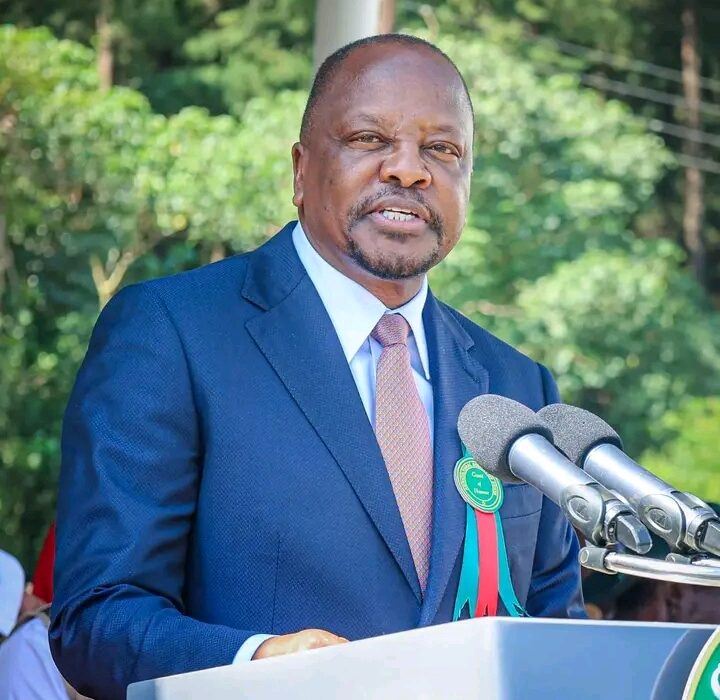
The fifth Kenya Meat Expo has opened at the Kenyatta International Convention Centre (KICC) in Nairobi, bringing together farmers, investors, processors, innovators, researchers, traders and other players in the livestock and meat industry as the government seeks to unlock greater economic opportunities from the sector.
The three-day event, running from August 26 to 28, 2026, is focusing attention on the entire meat value chain, from livestock production and animal health to processing, technology, marketing, logistics and retail.
The expo is being held under the theme “Accelerating Sustainable Growth: Empowering the Next Generation in the Meat Value Chain.”
Agriculture and Livestock Development Cabinet Secretary Sen. Mutahi Kagwe has called on farmers, investors and industry stakeholders to use the event to establish partnerships, explore investment opportunities and find ways of increasing the value generated from livestock.
The Kenya Meat Expo 2026 is bringing together government institutions, private-sector companies, farmers, investors and innovators, with organisers saying the event is designed to create opportunities for investment, innovation and employment across the meat industry. The expo is open to the general public and is running from 8am to 5pm daily.
The event comes at a time when the government is placing livestock at the centre of its plans to expand agricultural production, create jobs and increase household incomes. According to the Kenya Investment Authority, livestock contributes about 12 per cent of Kenya’s GDP and supports more than 25 million livelihoods.
Kagwe has outlined an ambitious plan to raise the contribution of livestock to Kenya’s GDP from the current 12 per cent to 20 per cent. The government also wants to nearly double annual meat production from 527,200 metric tonnes recorded in 2022 to almost 990,000 metric tonnes by 2028.
According to the Cabinet Secretary, achieving the target could generate an estimated Sh450 billion annually for the economy. The government therefore views the livestock industry not only as a source of food and income but also as a major platform for industrialisation, job creation and export growth.
However, Kagwe has cautioned that increasing production alone will not be enough to make Kenya a major player in the global meat trade. The country must improve animal health, food safety, traceability, quality assurance, processing and marketing if farmers and businesses are to benefit from high-value domestic and international markets.
Speaking during the Kenya Meat Conference in Nyeri in July, Kagwe warned that antimicrobial resistance caused by misuse of veterinary medicines could undermine Kenya’s ambitions in the meat export market.
“Responsible use of veterinary medicines is becoming a passport to international markets,” Kagwe said, stressing the growing importance of compliance with international food-safety requirements.
The CS also warned that international buyers are increasingly interested in more than the meat itself. They want assurance about how animals were raised, treated and processed, as well as evidence that products meet strict safety and quality standards.
“They purchase trust. That trust must now become Kenya’s greatest export,” Kagwe said.
The government is consequently strengthening animal-health systems and traceability mechanisms. Kagwe said Kenya is rolling out the Livestock Identification and Traceability System and the Animal Identification and Traceability System to improve the ability to track livestock from farms to markets.
Such systems are expected to improve transparency within the livestock sector while helping Kenya meet the requirements of international buyers seeking traceable and disease-free meat products.
Animal vaccination is also a key component of the government’s strategy. Kagwe has said the National Livestock Vaccination Programme will continue targeting trade-sensitive diseases that have historically limited Kenya’s access to premium markets. The government is also investing in the Kenya Veterinary Vaccines Production Institute, with plans to increase annual vaccine production from about 45 million doses to more than 70 million doses.
The government is further calling for greater investment in modern meat-processing facilities, abattoirs, certification and branding. Kagwe has said Kenya must move beyond the sale of raw livestock and increase value addition so that farmers and other participants can earn more from the sector.
This is particularly important for smallholder livestock keepers and pastoralists, who form a significant part of Kenya’s livestock production system. Improved access to organised markets, processors and exporters could give producers stronger bargaining power while reducing dependence on informal livestock markets.
The expo is providing an opportunity for such producers to interact with processors, buyers, technology companies, animal-health experts, feed manufacturers and financial institutions. Exhibitors are showcasing technologies and services covering animal nutrition, breeding, livestock tracking, processing and retail.
The participation of organisations working with livestock producers is also expected to strengthen market linkages. Heifer International Kenya, for example, is using the expo to connect livestock producers with buyers, feedlot operators and export markets while showcasing solutions aimed at improving production, market access and resilience among pastoralist communities.
For investors, the growing demand for meat in Kenya and across the region presents opportunities in livestock production, feed manufacturing, animal health, breeding, transportation, cold-chain logistics, meat processing, packaging and retail.
The government is hoping that stronger partnerships between national and county governments, private investors, researchers and financial institutions will help transform Kenya into a competitive exporter of safe, traceable and high-quality meat products. Kagwe has repeatedly called for such collaboration as part of the broader reforms targeting the livestock economy.
As the Kenya Meat Expo continues at KICC, the focus is therefore shifting from simply producing more livestock to building a modern and profitable value chain capable of creating employment and generating higher returns for farmers.
For farmers, the event offers an opportunity to learn about new technologies, market requirements and value-addition opportunities. For investors, it provides a platform to identify emerging opportunities in one of Kenya’s largest agricultural subsectors.
With the government targeting nearly one million tonnes of annual meat production by 2028 and a livestock economy capable of generating Sh450 billion annually, the success of the sector will depend on how effectively Kenya connects farmers to markets, strengthens animal health and food safety, expands processing capacity and captures more value before meat reaches consumers.
The fifth Kenya Meat Expo is consequently more than an exhibition. It is part of a wider push to transform livestock farming into a more productive, competitive and investment-driven industry capable of improving livelihoods, creating jobs and strengthening Kenya’s position in regional and international meat markets.

Author: Moureen Koech
Moureen Koech is a passionate Digital Journalist, an adept Agribusiness Writer with a keen eye for news and an impactful story-teller,whose stories provide key value to Agripreneurs and stakeholders in the Agricultural sector