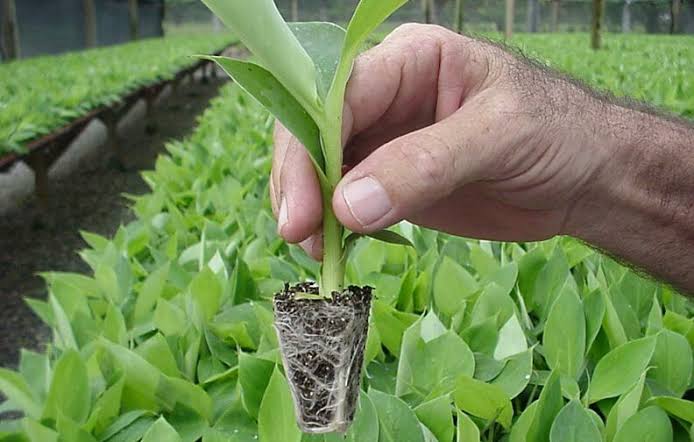
Tissue culture banana farming is becoming an increasingly attractive option for farmers looking to establish productive commercial banana farms in Kenya. Unlike traditional banana suckers collected from existing plantations, tissue culture seedlings are produced under controlled laboratory conditions and hardened before being supplied to farmers.
The use of quality planting material can give farmers a more uniform crop and make plantation management easier. However, good seedlings alone do not guarantee high yields. Farmers also need suitable soils, adequate water, proper spacing, good nutrition, pest and disease management and access to reliable markets.
Why choose tissue culture banana seedlings?
One of the main advantages of tissue culture banana seedlings is uniformity. Farmers can establish plantations with plants that are relatively similar in age and growth, making activities such as fertilizer application, irrigation, desuckering and harvesting easier to organize.
Quality tissue culture planting material can also help reduce the risk of introducing pests and diseases associated with poorly selected or infected traditional planting materials.
Another attraction is the potential for earlier and more uniform production when the crop receives good management. Depending on the variety and growing conditions, bananas can begin producing within roughly 8 to 14 months.
Tissue culture bananas are also suitable for commercial production because farmers can select varieties according to their target market. Cooking bananas, dessert bananas and plantains can serve different consumer needs, allowing farmers to develop a production strategy around their preferred market.
Choosing the right banana variety
Farmers should avoid choosing a banana variety simply because it is popular in another area. The right variety should be selected based on the local climate, soil, water availability, consumer demand and intended market.
Cooking banana varieties can include Uganda Green, commonly associated with Ndizi Kisukari, Ng’ombe and Giant Cavendish. These varieties can be considered by farmers targeting cooking and local fresh markets, depending on the characteristics of the particular planting material.
For fresh consumption, farmers can consider varieties such as Williams Hybrid, Grand Nain, Dwarf Cavendish, FHIA-17 and FHIA-18. These varieties are suited to different production and market conditions, so farmers should confirm the characteristics and market demand before purchasing seedlings.
The most important consideration is to identify the market before establishing a large plantation. A farmer producing bananas without knowing where the crop will be sold may face challenges even when yields are good.
Where can bananas grow in Kenya?
Bananas perform best in warm areas with adequate moisture and fertile, well-drained soils. They can grow in different soil types, including loam, sandy loam and clay loam, provided drainage and fertility are properly managed.
Adequate sunlight is also important for healthy growth and fruit development. Farmers should avoid areas where bananas will be exposed to prolonged waterlogging. At the same time, moisture stress can significantly affect plant development and bunch formation, making irrigation particularly useful in areas with unreliable rainfall.
Strong winds can also damage banana leaves and cause plants to fall. Farmers establishing commercial plantations should therefore consider wind protection and site selection when planning their farms.
Banana spacing and land preparation
Spacing should be determined by the banana variety, soil fertility, irrigation system and management practices. A spacing of approximately 2.5 metres by 2.5 metres is commonly used in high-density banana production. At this spacing, about 640 planting positions can theoretically fit on one acre before accounting for pathways, boundaries and other farm infrastructure.
Farmers should avoid overcrowding plants simply to increase the number of seedlings. Excessive competition for sunlight, water and nutrients can negatively affect crop performance.
Before planting, farmers should clear the land and prepare the soil properly. Soil testing is recommended because it provides information about soil fertility and nutrient requirements.
Planting holes should be adequately prepared, with approximately 60cm by 60cm by 60cm often used as a guide. Well-decomposed manure or compost can be incorporated into the soil to improve soil structure and fertility.
When transplanting tissue culture seedlings, farmers should water them adequately, position them properly in the hole and avoid planting them too deeply.
Water and nutrition are critical
Water is one of the most important factors in successful banana farming. Newly planted tissue culture seedlings require adequate moisture as they establish their root systems. During dry periods, irrigation can help maintain consistent growth.
Drip irrigation can be considered where practical because it allows farmers to supply water directly to the crop. Mulching can also help conserve soil moisture, suppress weeds and add organic matter as it decomposes.
Bananas are heavy feeders, particularly under commercial production. Farmers should develop a nutrition programme based on soil-test results, crop requirements and the stage of production.
Nitrogen supports vegetative growth, while potassium plays an important role in fruit development and bunch quality. Organic manure and balanced fertilizers can form part of a comprehensive banana nutrition programme.
However, fertilizer application should not be based solely on a general recommendation. Soil conditions differ from one farm to another, making soil testing an important step before making major fertilizer investments.
Desuckering, pest and disease management
Proper sucker management is essential for maintaining an organized banana plantation. If too many suckers are allowed to grow, plants may compete for water, nutrients and sunlight.
Farmers should retain healthy replacement suckers while removing unwanted shoots. The exact number to retain should depend on the production system and management objectives.
Regular scouting is equally important. Farmers should inspect plants for unusual leaf symptoms, poor growth, pest damage, root and corm problems and other signs of disease or nutrient deficiencies.
Starting with quality planting material is only one part of disease management. Good sanitation, proper spacing, drainage, weed control and regular monitoring should also be incorporated into the farm management programme.
How long do tissue culture bananas take to mature?
The time required for bananas to produce a harvest varies according to variety and management conditions. Under favourable conditions, some tissue culture bananas may begin producing within approximately 8 to 12 months, while other production guides indicate about 10 to 14 months.
Temperature, water availability, soil fertility, variety, sunlight, weed control and pest and disease pressure can all influence maturity.
Farmers should therefore avoid using a fixed number of months as the only measure of crop readiness. Proper assessment of plant development and harvest maturity is more important.
Is tissue culture banana farming profitable in Kenya?
Bananas have an established market in Kenya, with demand coming from households, hotels, restaurants, institutions, retailers, wholesalers and urban consumers.
Cooking bananas can target local food markets, while dessert varieties can serve fresh-fruit markets. There are also opportunities for value addition where farmers have sufficient production and access to suitable processing markets.
However, farmers should calculate the entire cost of production before establishing a commercial plantation. Expenses may include land preparation, seedlings, manure, fertilizer, irrigation, labour, crop protection, harvesting, transportation and post-harvest handling.
The price of a seedling alone should not be used to determine whether banana farming will be profitable.
Tissue culture banana seedlings in Kenya
Farmers looking for tissue culture banana seedlings can find different varieties marketed for cooking, fresh consumption and other purposes. Prices can vary depending on the variety, supplier and quantity purchased.
Prices can range approximately KSh 250 to KSh 500 per tissue culture banana seedling, although farmers should confirm the current price and availability directly with the supplier before ordering.
For commercial farmers, it is also important to purchase planting material from a reputable source and seek appropriate agronomic guidance when establishing a new plantation.
Tissue culture banana farming can provide Kenyan farmers with a more organized way of establishing commercial banana plantations. Uniform planting material can make farm management easier, but productivity ultimately depends on the entire production system.
Farmers should choose varieties according to market demand, prepare their soils properly, maintain adequate moisture, provide balanced nutrition, control weeds and suckers, monitor pests and diseases and plan their market before planting on a large scale.
The goal should not simply be to plant more bananas, but to build a well-managed banana enterprise capable of producing quality fruit consistently and connecting it to a reliable market.

Author: Moureen Koech
Moureen Koech is a passionate Digital Journalist, an adept Agribusiness Writer with a keen eye for news and an impactful story-teller,whose stories provide key value to Agripreneurs and stakeholders in the Agricultural sector