Goat meat farming is becoming an attractive agribusiness for farmers looking for livestock that can generate income without requiring as much space as cattle. Goats are adaptable, reproduce relatively quickly and can utilize a variety of feeds and vegetation.
However, not all goat breeds are equally suited for meat production. Some are better for milk, while others are valued for both meat and milk. Choosing a breed with good growth, body size, reproductive performance and adaptability can have a major impact on the profitability of a meat goat enterprise.
For farmers in Kenya, the best choice should also consider the local climate, availability of feed, disease pressure and the preferences of the target market.
1. Boer Goats
The Boer goat is one of the most recognized meat goat breeds in the world. It originated in South Africa and was specifically developed for meat production.
Boer goats are known for their fast growth, muscular bodies and good carcass characteristics. Mature animals can reach relatively large body weights when provided with good nutrition and management.
One of their biggest advantages is their potential for crossbreeding. Farmers can cross Boer bucks with local does to combine the growth and meat characteristics of Boer goats with the adaptability of local animals.
The main challenge is that pure Boer goats can be relatively expensive to acquire and may require good feeding and management to achieve their genetic potential.
2. Galla Goats
The Galla goat, also known as the Boran goat in some contexts, is an important indigenous goat breed in East Africa and is well adapted to relatively dry environments.
Galla goats are valued for their hardiness and ability to survive under challenging conditions. They can be particularly suitable for farmers in arid and semi-arid areas where feed and water availability can fluctuate.
Although they may not grow as rapidly as specialized meat breeds such as the Boer, their adaptability can make them a practical choice for smallholder farmers.
3. Small East African Goats
Small East African goats are widely kept by smallholder farmers across the region.
They are generally hardy and can survive under relatively low-input production systems. Their smaller body size means they may not produce as much meat per animal as larger breeds, but their adaptability is a major advantage.
They can also be used in crossbreeding programmes with larger meat breeds to improve growth and mature size while retaining some local adaptation.
4. Kalahari Red Goats
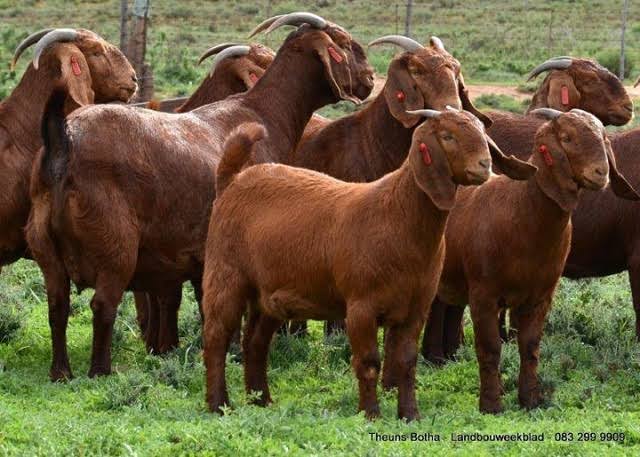
Kalahari Red goats are another South African meat breed known for their ability to perform in challenging environments.
They have a distinctive reddish-brown colour and are valued for meat production, growth and maternal characteristics.
Their ability to tolerate relatively harsh conditions makes them potentially useful in environments where farmers want a meat breed that can cope with heat and extensive production systems.
As with any specialized breed, farmers should consider the availability and cost of breeding stock before investing.
5. Savanna Goats
Savanna goats are another South African breed developed for meat production.
They are known for their hardiness, good growth and ability to perform in extensive production systems.
Their adaptability can make them attractive for farmers looking for a meat-oriented breed that can cope with relatively demanding environmental conditions.
However, farmers should evaluate whether breeding stock is readily available and whether there is a market for the animals in their area.
6. Anglo-Nubian Goats
Anglo-Nubian goats are primarily known as dairy goats, but they can also provide useful meat because of their relatively large body size.
They may be suitable for farmers interested in a dual-purpose enterprise where milk and meat are both important sources of income.
However, if meat production is the only objective, specialized meat breeds are generally more appropriate.
7. Toggenburg and Other Dairy Breeds
Toggenburg goats are primarily dairy animals and are not usually the first choice for farmers whose main goal is meat production.
Nevertheless, they can contribute to a mixed livestock enterprise where farmers value milk production and want additional income from male kids or animals that are no longer productive.
The important point is to choose breeds according to the main objective of the business.
Which goat breed is best for kenyan farmers?
There is no single breed that is best for every farmer.
For a farmer targeting fast growth and high meat yields, Boer goats can be an attractive option.
For farmers in dry or harsh environments, Galla and other locally adapted goats can be more practical because they are better suited to local conditions.
For farmers who want to combine the strengths of different breeds, crossbreeding can be a useful strategy. For example, crossing a Boer buck with well-adapted local does can potentially produce offspring with improved growth while retaining some local adaptability.
However, crossbreeding needs to be planned carefully. Farmers should select healthy breeding animals with good growth and reproductive characteristics rather than focusing on breed names alone.
What should you consider before buying meat goats?
Adaptability
A goat that performs well in one environment may not perform equally well in another. Consider your climate, available pasture, housing and disease challenges before purchasing breeding stock.
Growth Rate
For a meat business, faster-growing animals can reduce the time and resources required to reach the desired market weight.
However, growth depends on genetics, nutrition, health and management. A good breed will not perform well if it is poorly fed.
Feed availability
Before investing in a large herd, determine whether you have enough pasture, fodder or supplementary feed.
Feed costs can significantly affect profitability, especially when keeping large meat breeds.
Reproductive performance
A profitable meat goat enterprise needs regular production of kids.
When selecting breeding animals, consider fertility, kidding history, mothering ability and kid survival in addition to body size.
Disease resistance and hardiness
A hardy goat that survives and reproduces well under local conditions can be more valuable to a smallholder farmer than a high-performing breed that requires expensive management.
Market demand
Before choosing a breed, find out what buyers in your area want.
Some markets prefer large goats, while others are more interested in smaller animals at particular ages and weights. The price a farmer receives ultimately depends on the market.
How to make meat goat farming profitable
Breed selection is only one part of the business.
Farmers should provide adequate nutrition, clean water, appropriate housing and good disease prevention. Young goats should receive proper care, while breeding animals should be selected based on performance rather than appearance alone.
Keeping farm records is also important. Record births, deaths, treatments, breeding dates, growth and sales. This allows the farmer to identify productive animals and remove poor performers.
Farmers should also calculate the cost of raising each animal. A goat that sells for a good price is not necessarily profitable if it required excessive expenditure on feed, treatment and labour.
Boer, Galla, Kalahari Red, Savanna and Small East African goats can all play a role in meat production, depending on the farmer’s production system and location.
For many Kenyan smallholder farmers, locally adapted goats and carefully planned crosses may offer a practical balance between growth, hardiness and production costs.
The best breed is ultimately not just the one with the largest body size. It is the breed or combination of breeds that performs well in your environment, reaches market weight efficiently, reproduces reliably and produces animals that buyers are willing to pay for.Before investing heavily, study your local market, calculate feed and management costs and seek advice from a qualified livestock or veterinary professional.

Author: Moureen Koech
Moureen Koech is a passionate Digital Journalist, an adept Agribusiness Writer with a keen eye for news and an impactful story-teller,whose stories provide key value to Agripreneurs and stakeholders in the Agricultural sector